Key points
- University of California, Berkeley researchers used OpenAI’s Astra to generate a full 3D simulation with correct lighting and materials within one hour.
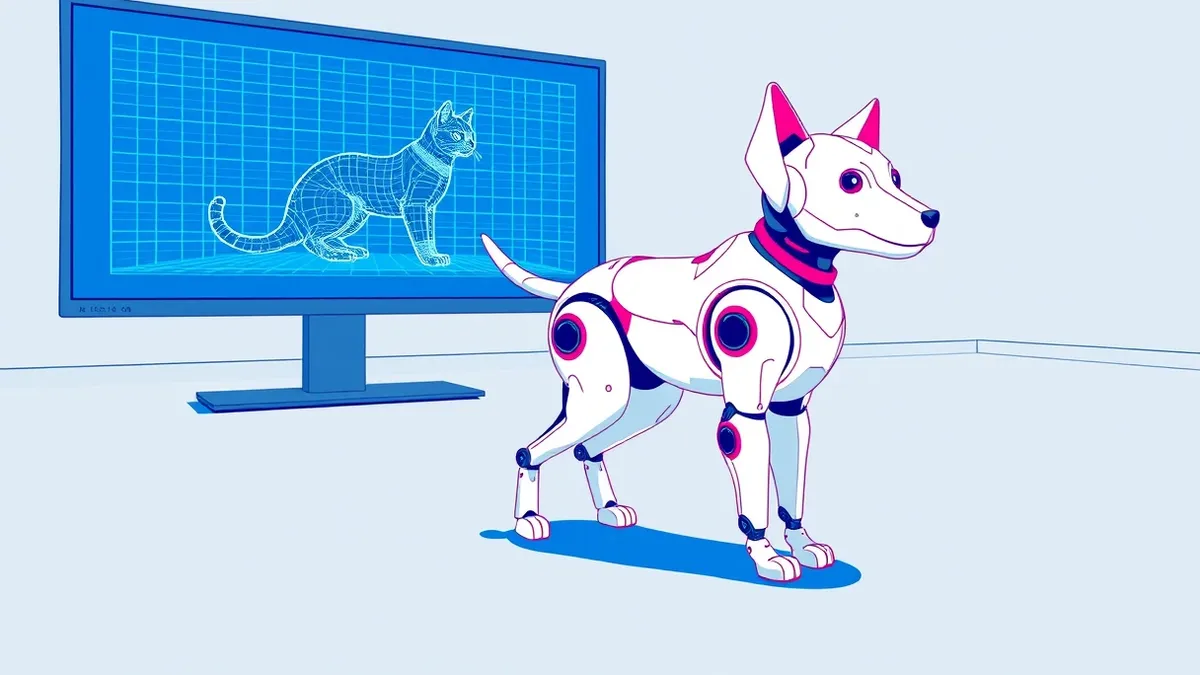
According to a report in Wired, OpenAI’s GPT-6 Sol model allowed a journalist to programme and train a virtual version of the Microduck robot in only a few hours.reported
How we got here
Accurate simulations are essential for ensuring that complex behaviours, such as grasping or dancing, transfer correctly from virtual environments to physical hardware.
What is new
Goldberg’s team gave Astra access to Nvidia’s Newton tool and provided it with a video clip of a real robot. This automation handles much of the tedious work involved in setting up simulation environments and running training experiments.
Where this leaves builders
The writer of the Wired piece is currently awaiting a physical Microduck unit from Pollen Robotics and Hugging Face. The plan is to transfer the simulated behaviour to the real device, potentially adding a feature where the robot bows its head to dispense a treat from a 3D-printed storage chamber. The writer notes that because simulated behaviour is relatively simple, the transition to the physical robot should be straightforward.
What the paper shows
The Wired report highlights that OpenAI’s latest models excel at understanding and manipulating 3D representations of the physical world.reported The research demonstrates that these models can translate that understanding into useful code, agentic actions and robot training data. The stated limitation is that the writer has not yet tested the trained behaviour on the physical Microduck, as the hardware has not been shipped. The success relies on the assumption that simple simulated behaviours will transfer faithfully to the real device.
Why it matters
- Enterprise IT buyers can significantly reduce the time and labour costs associated with setting up robotic simulation environments.
- The ability to generate accurate 3D simulations from video clips lowers the barrier to entry for developing complex robotic behaviours.
- Automated simulation setup allows for faster iteration and testing of robotic agents before physical deployment.
Topics: OpenAI, robotics, simulation, Nvidia, GPT-6
Updated
Then / now / next
Creating accurate 3D simulations for robot training was a manual process that could take weeks.
AI models can generate detailed simulations with correct parameters from video clips within an hour.
Developers will test whether these simulated behaviours transfer effectively to physical hardware like the Microduck.
Story timeline
- Then Creating accurate 3D simulations for robot training was a manual process that could take weeks.
- 11 Nov 2026 I Saw the Future of Robotics in a Virtual Duck That Chases My Cat
- Now AI models can generate detailed simulations with correct parameters from video clips within an hour.
- Next Developers will test whether these simulated behaviours transfer effectively to physical hardware like the Microduck.
The strongest doubt
Counterpoint from the sources
The writer has not yet confirmed that the simulated behaviour will work on the physical Microduck, as the hardware has not been received.
For readers
Researchers
- Can use AI to automate the tedious setup of simulation parameters.
- May reduce the time required for training complex robotic behaviours.
Developers
- Can leverage GPT-6 Sol for rapid coding and training of virtual robots.
- Should evaluate the transferability of simple simulated behaviours to physical devices.
Investors
- OpenAI’s models are expanding into physical robotics simulation and training.
Ask the article
Local keyword search of this article; no generated answers.Did this article give you the evidence you needed?
Your choice stays on this device. No public tally.Questions readers ask
How long did it take to create the virtual robot simulation?
The writer reported that coding and training the virtual Microduck took only a few hours, compared to weeks previously.
Connected stories
Reading receipt
- University of California, Berkeley researchers used OpenAI’s Astra to generate a full 3D simulation with correct lighting and materials within one hour.
Still open: Will the simulated walking and identification behaviours transfer successfully to the physical Microduck hardware?
Still open: How accurate are the Astra-generated simulations for more complex robotic tasks beyond simple navigation?