Key points
- GR00T 2 uses a world-action model to predict future video frames and motor movements simultaneously.
- Success rates in lab tests ranged from 10 to 80 percent, depending on the task.
Nvidia published a research report on GR00T 2, introducing an AI foundation model designed to shorten the process of teaching robots new tasks.reported According to The Decoder, the system aims to replace laborious teleoperation by transferring human movements captured in video directly to robotic arms.reportedNvidia’s new AI model teaches robots by watching videos of humans, cutting down on manual training.GR00T 2 employs a world-action model to predict future states and motor commands from human video demonstrations.
Evidence: reported
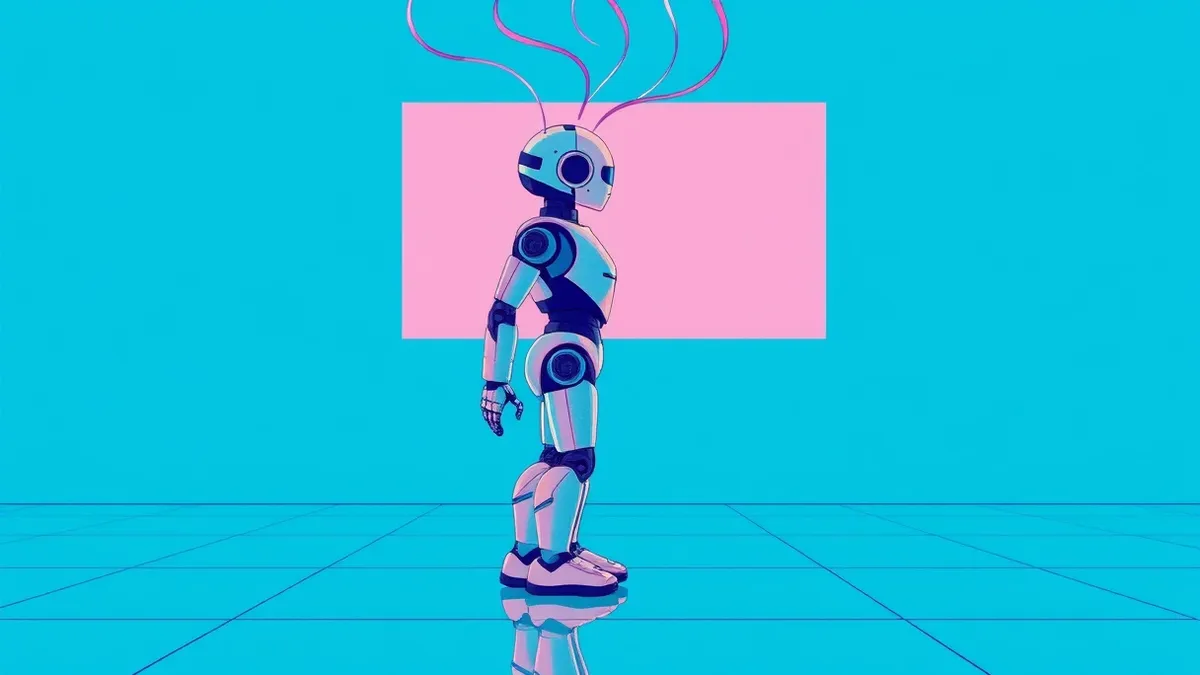
Nvidia's model GR00T 2 watches humans on video, then imagines itself as the robotaifleet-decoder
Evidence: reported
Nvidia's model GR00T 2 watches humans on video, then imagines itself as the robotaifleet-decoder
How we got here
Historically, engineers have devoted hours to the remote control of machines for training data generation, a method referred to as teleoperation. The Decoder reported that this method is expensive, slow, and requires separate data collection for every robot model.reported Earlier methods, such as Nvidia's GR00T 1, converted camera feeds and verbal instructions straight into motor actions.reported
Evidence: reported
Nvidia's model GR00T 2 watches humans on video, then imagines itself as the robotaifleet-decoder
Evidence: reported
Nvidia's model GR00T 2 watches humans on video, then imagines itself as the robotaifleet-decoder
What is new
GR00T 2 functions as a world-action model that concurrently determines the subsequent motion and a brief preview of the near future.reported
Evidence: reported
Nvidia's model GR00T 2 watches humans on video, then imagines itself as the robotaifleet-decoder
Where this leaves builders
To teach a robot a new task, researchers say a person can demonstrate steps using data gloves or finger exoskeletons. By merging these recordings with the target robot's general motion data, the AI produces a video prediction featuring the robotic arm instead of the human arm and extracts the corresponding control commands from that output. Nvidia combines the system with a higher-level language model, such as OpenAI’s GPT-6 Astra, for extended assembly tasks.reported
Evidence: reported
Nvidia's model GR00T 2 watches humans on video, then imagines itself as the robotaifleet-decoder
What the paper shows
During laboratory trials, a five-fingered robot executed actions like igniting a match, cutting a banana, and throwing packages onto a conveyor belt without undergoing task-specific teleoperation. Success rates varied between 10 and 80 per cent depending on the task.reported From a single video, the system learned to hammer nails via simulation. For 50 chosen tasks, under three minutes of standard training boosted success rates from 40 to 95 percent.reported
Evidence: reported
Nvidia's model GR00T 2 watches humans on video, then imagines itself as the robotaifleet-decoder
Evidence: reported
Nvidia's model GR00T 2 watches humans on video, then imagines itself as the robotaifleet-decoder
Why it matters
- Enterprise buyers can reduce the high cost and time associated with collecting teleoperation data for each robot model.
- The wide variance in success rates (10 to 80 per cent) suggests additional conventional training may still be required for reliable deployment.
- Training on 400,000 hours of video indicates significant infrastructure investment, requiring clusters of GB300 chips.
- Integration with higher-level models like GPT-6 Astra adds complexity but may improve error handling for longer assembly sequences.
Topics: Nvidia, robotics, AI models, GR00T, machine learning
Updated
Then / now / next
Robot training relied on expensive, slow teleoperation for each model.
GR00T 2 uses video-based world-action modelling to transfer human movements to robots.
Monitor how success rates hold up outside controlled lab environments.
Story timeline
- Then Robot training relied on expensive, slow teleoperation for each model.
- 10 Nov 2026 Nvidia's model GR00T 2 watches humans on video, then imagines itself as the robot
- Now GR00T 2 uses video-based world-action modelling to transfer human movements to robots.
- Next Monitor how success rates hold up outside controlled lab environments.
Ask the article
Local keyword search of this article; no generated answers.Did this article give you the evidence you needed?
Your choice stays on this device. No public tally.Questions readers ask
How does GR00T 2 differ from previous models?
Unlike GR00T 1, it uses a world-action model that predicts both future video frames and motor movements simultaneously.
Can it learn from a single video?
The system acquired the ability to hammer nails through a computer simulation using just one video of a human hand movement.
Connected stories
Reading receipt
- GR00T 2 uses a world-action model to predict future video frames and motor movements simultaneously.
- Success rates in lab tests ranged from 10 to 80 percent, depending on the task.
Still open: How does the system perform in unstructured, real-world environments outside the lab?
Still open: What is the impact of pairing with GPT-6 Astra on overall system latency?