Key points
- Stingray Marine Solutions has deployed over 3,500 AI submarine drones along the Norwegian coast.
- The system protects more than 112 million fish, covering roughly 20-25% of the country's farmed salmon.
- Deployments increased by approximately 1,000 units in the last year, marking significant commercial growth.
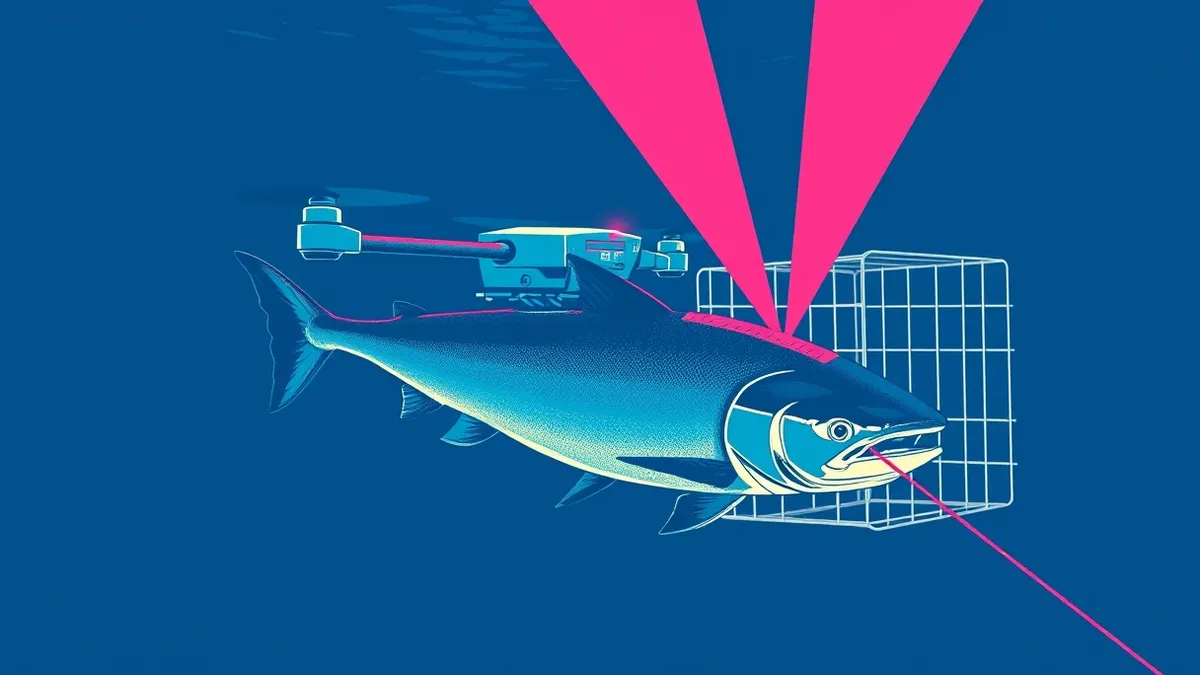
Tom's Hardware reported that Stingray Marine Solutions has expanded its fleet of AI-powered submarine drones to over 3,500 units, protecting more than 112 million salmon along the Norwegian coast.reported This represents one of the largest commercial AI deployments in Scandinavia.Stingray Marine Solutions uses underwater robots with lasers to kill parasites on salmon without using harmful chemicals.
Evidence: reported
3,500 laser-armed AI submarine drones patrol Norwegian salmon farms, killing sea lice and protecting 112 million fishaifleet-tomshardware
How we got here
Sea lice pose a persistent challenge for fish farmers, traditionally requiring chemical treatments that stress fish, harm the environment and risk resistance. Stingray Marine Solutions, based in Oslo, developed an alternative using AI-enhanced submarines to identify and target parasites optically.
What is new
The company increased its deployment by about 1,000 units over the previous year.reported These robots now protect an estimated 20-25% of farmed salmon in Norway, operating continuously within salmon pens to reduce mortality and improve welfare without introducing toxins into the food chain.reported
Evidence: reported
3,500 laser-armed AI submarine drones patrol Norwegian salmon farms, killing sea lice and protecting 112 million fishaifleet-tomshardware
Evidence: reported
3,500 laser-armed AI submarine drones patrol Norwegian salmon farms, killing sea lice and protecting 112 million fishaifleet-tomshardware
Where this leaves builders
The operation now employs 250 people. While the technology avoids chemical resistance, the up-front costs remain a consideration for farming businesses. The system is best used as a preventative measure to keep localized lice populations low rather than treating large infestations after they occur.
What the paper shows
The source material describes a commercial deployment rather than an academic study. The AI recognises and targets sea lice using lasers, allowing fish to swim normally. Results cited include reduced mortality and cleaner fish. A stated limitation is that the Stingray’s range is confined to the pens, allowing lice to gather in darker corners or outside the patrol area.
Why it matters
- Optical delousing reduces reliance on harsh chemical baths, addressing environmental and resistance concerns in aquaculture.
- Continuous 24/7 operation allows for preventative control rather than reactive treatment of large populations.
- High upfront deployment costs may limit adoption for smaller farming operations despite long-term welfare benefits.
- Limited patrol range means lice can still accumulate in areas outside the drone's operational zone.
Topics: AI, aquaculture, automation, robotics, Norway
Updated
The strongest doubt
Counterpoint from the sources
The up-front costs of deployment may be prohibitive for some farming businesses, and the system’s limited range allows lice to gather outside the patrol area.
For readers
Investors
- Stingray has grown to one of the largest commercial AI deployments in Scandinavia
- The company now employs 250 people and has over 3,500 units deployed
Policy
- The technology reduces chemical use in food production and protects wild fish populations
- It offers a sustainable alternative to traditional parasite control methods
Business
- High upfront costs remain a barrier for some farming operations
- The system is best used as a preventative measure rather than a cure
Ask the article
Local keyword search of this article; no generated answers.Did this article give you the evidence you needed?
Your choice stays on this device. No public tally.Questions readers ask
How many fish does the Stingray system protect?
The system protects over 112 million fish, covering approximately 20-25% of farmed salmon in Norway.
What are the main drawbacks of this technology?
High upfront costs and limited range within pens, which allows lice to gather in darker or external areas.
Does the system use chemicals?
No, it uses lasers to optically delouse fish, avoiding chemical introduction and potential resistance issues.
Connected stories
Reading receipt
- Stingray Marine Solutions has deployed over 3,500 AI submarine drones along the Norwegian coast.
- The system protects more than 112 million fish, covering roughly 20-25% of the country's farmed salmon.
- Deployments increased by approximately 1,000 units in the last year, marking significant commercial growth.
Still open: How does the AI accuracy rate compare to manual or chemical treatments?
Still open: What is the specific cost per unit or per fish protected?